

C
hristos is known to us as our Papoú, Gran-Papoú, Thios, Gran-Thios, Uncle Christos, aderfós (brother), and a filos (friend). He is the "quintessential" Ballas, full of personality and charm. He was a humble man and was devoted to his family.
Christos was born in Kiato, Greece, and lived there all his life. He was a very young boy when his six brothers left for America, but seemed to carry their memory and spirit with him every day of his life. He lived through periods of struggle during the poor economic times and Germany's occupation of his home during World War II. In the end, he remained upbeat and always seemed to enjoy life. Christos loved his family and his home town. Everyone was his friend. It was indeed a pleasure to know him.
Christos was very social and enjoyed telling stories. In this regard he was very much like his brother, Louie, who told his own stories to friends and family in America.
The following two stories are his originals. These tales of Ballas ancestors contribute to our being "uniquely Ballas". There is a historical fabric to these stories and they are a product a man who was self-educated and worldly in his own right. As you read them, try to picture a 70 year old man, with a smile on his face and a twinkle in his eyes, telling you these stories. He will be animated, will use hand gestures, and run about the room as these stories unfold.

THE BIG 'BALA'
Many years ago, about 600 years ago, there lived a relative of ours who was a very brave man. He lived during a very dark period in the history of Greece; a period when Greece was occupied by the foreign invaders from Turkey. These Turkish invaders were referred to by the history books as being from the Ottoman Empire. They were mean and fierce invaders and once they took over our country they ruled the people with an iron hand. They marched on village after village with reckless abandon. As they pummeled through each village they either enslaved or killed all the Greek men, and had their way with any of the Greek women they wanted. It is said that most Greeks born during this Turkish occupation were born with the tainted, evil blood of these cruel invaders.
But, some of the Greeks did not give in to these invaders without a fight. Even when their village was overtaken and they appeared helpless, the men escaping torture or death formed small guerilla bands. Our family village of Kiato was one such village where a small group of men escaped and hid out in the nearby hills. The leader of this band was our great-great-great grandfather, who was named Georgius Kelaris.
Georgius Kelaris was a very tall and strong man. He was well over seven feet tall and carried a very long sword. In fact, only a man of his great height could carry such a sword because it would drag on the ground if a shorter man tried to carry it.
(Christos gets very excited at this point; he stands up and raises his hand horizontally over his head as far as he can to indicate the great height of this man, Kelaris. He also paces across the room with long, exaggerated steps to demonstrate the length of the sword.)
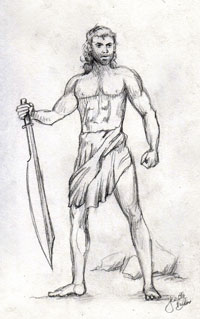
In an act of desperation, the Turkish commander offered a reward to any Greek citizen who would provide information as to the whereabouts of Georgius Kelaris. It was hard to believe any fellow Greeks would actually help the Turks, but some did. In fact, it was Georgius' own brothers who came to the Turkish commander and told him of the current hiding place of their fighting brother. Georgius was captured and placed in a fenced corral that held the horses and cattle at the Turks encampment.
On the first night of Georgius' captivity the Turkish guards checked on him and saw that the walls were so high he could never escape. However, they were wrong because during the dead of night, Georgius Kelaris, a strong man of over seven feet in height, lifted one of the horses over the high wall, climbed the wall himself, and rode away into the night.
The next morning, the Turkish commander was furious. He had lost his prisoner after only one day in captivity. The commander wondered, "How could this Kelaris man be so strong to have done such a thing, how could he lift a horse over a wall that was almost 10 feet high!" So, he told the people that if they would get word to Kelaris and ask him to come back to the encampment and demonstrate how he lifted the horse over the wall he would gain the respect of the entire Turkish army and, at the same time, would gain his freedom forever.
Georgius heard this offer and was intrigued by the chance to live as a free man forever. A few days later, Georgius proudly rode directly into the encampment and into the corral. He dismounted then lifted his own horse over the wall and climbed over it just as he had done on the night of his capture. However, instead of setting him free, the Turkish soldiers set a trap for Georgius and re-captured him before he could ride away. Wanting no more escape attempts by this guerilla fighter, the Turkish commander had Georgius quickly beheaded.
(When Christos is asked how our family name came to be Ballas, the twinkle in his eyes becomes ever brighter, he knows this question would be posed and continues on with the story.)
During the years when the Turks were fighting with Georgius and trying to capture him, the soldiers had all come to witness Georgius yield his big sword. It seems that the word the Turks used for a sword was something like "pala". As they told stories and recounted battles with Georgius, the Greeks heard these strange Turks speaking and thought they were saying "bala," and heard them referring to him as the "Big Bala". So, as the years went on, and the stories of the bravery and strength of Georgius Kelaris were told, the Greeks themselves started to call him by the name Big Bala. The name "Big Bala" eventually became more common and evolved from Bala to Balas and finally to the Greek spelling of Ballas.
THE BALLAS STRONGMAN
WITH A TAIL
Many, many years ago we had another ancestor who was very big and strong. He was from a time when peoples from North Africa sailed the Mediterranean Sea and visited places like Greece, Italy and Sicily. The visitors who came to Greece were sometimes friendly and traded goods with our people, but sometimes they were bad and tried to rob and steal from us. These African visitors came to almost all the coastal towns of Greece. They sailed across the big Mediterranean then they entered the Aegean Sea and came to the Peloponnese which is our part of Greece. They came to an area not too far from here, a coastal area overlooking the islands of Poros and Hydros. This part of the coast is flat at the top and is home to orchards of orange and lemon trees. The edge of this area of land drops off to the sea from with its very steep cliff and rocky outcroppings.
WITH A TAIL
In those days we had family living near this coast. One of the men from our Ballas family was this big strong man I am telling you about. He was known to fear no one. He was from old times and had a short tail at the base of his spine. It was thought in those days that men with a tail like his possessed extra strength.
(As Christos tells this part of the story, he will be running around the room holding his hand on his lower back and showing where the tail was located on the Ballas strongman.)
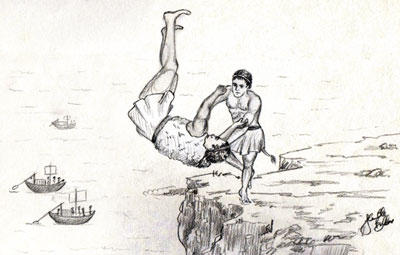
So there we have it. The Ballas with the tail was going to wrestle a giant from Africa. Now, according to those who have handed down this story through the generations, Ballas was not only very strong, but he was also very cunning. While the Greeks and the Africans were assembling around a makeshift wresting ring, Ballas offered a gift to the giant: a vest made of animal fur. The giant took the vest and put it on for the fight. He then boasted to his fellow Africans, "The Greek gives me a gift, but I will kill him anyway." Now, in keeping with the tradition of Greek wrestling, and as he prepared to do battle, Ballas rubbed olive oil all over his chest and arms. This was typically done by wrestlers to show off their bodies and accentuate their muscles.
As the match began, it was easy to see that the giant was much stronger than Ballas, but when he tried to grab his opponent, his hands slipped off. The clever Ballas knew the olive oil made would make it very difficult for the giant to get a grip. The giant chased and tried to grab Ballas, but he couldn't get a firm hold on him. After the giant became frustrated and very tired from chasing him around the ring, Ballas moved in to make his move. The animal vest made it easy for Ballas to get a good grip and when he did, he lifted his opponent over his head for all to see. The afternoon sun glistened off the oily skin of the Ballas strongman as he carried the giant over to the edge of the cliff, lifted him high above his head, and then threw him over the edge. The Greeks cheered their hero, while the Africans stared in disbelief as the body of the strongest among them bounced off the jagged rocks of the cliff wall. The Africans then went down the cliff and quietly boarded their small boats. They rowed out to the bigger boat and sailed away.
Thank you Christos for creating a seven foot tall Ballas, whose original name was Georgius Kelaris, and an ancestor who was a fearless strongman with a tail!
